All models: weak A/C cooling and noise — clogged condenser/radiators (how to clean)
Quick FAQ
Why is my Tesla's A/C suddenly cooling poorly?
How do I clean the Tesla condenser and radiator without removing the bumper?
Can I clean the Tesla condenser with a pressure washer?
How often should the front radiator be cleaned?
How much does condenser cleaning and replacement cost in Belarus?
What oil is in a Tesla's A/C system?
Can I refill a Tesla's A/C at a regular roadside shop?
Symptoms
- The A/C cools poorly, the cabin takes a long time to cool down.
- You can hear the fan/compressor running at high RPM.
- While parked the cooling "fades" faster than while driving.
Cause
The front heat-exchanger stack (A/C condenser, cooling radiator, etc.) gets clogged with fluff/dust/leaves. Condenser heat dissipation drops → refrigerant pressure and temperature rise → compressor runs at its limit and wears out faster. Tesla manuals have dedicated radiator/condenser cleaning procedures recommending blowing out / vacuum cleaning (see links).
What to do right now (without removing the bumper)
- Put the car into Service Mode.
- Remove the active grille and the plastic mesh/grille (where applicable) and vacuum the front heat exchanger (shop-vac, soft brush).
- For heavy soiling — compressed air at moderate pressure against the direction the debris was blown in. Don't bend the fins and don't use a Karcher pressure washer up close.
⚠️ Don't pour aggressive chemistry onto aluminum fins or electrical connectors. If more than 1 L of coolant is lost, the cooling loop requires vacuum refill (see manual).
When you have to disassemble
If dirt is deep between the stack/channels, the upper grille/reinforcement is removed or the radiator stack is lowered and cleaned from the inside (see Service Manual for condenser/radiator removal).
⚠️ A/C refill: POE oil only, never PAG (tsk.by)
If you plan to top up or refill the A/C system — first ask the shop what oil is in their rig. If it's PAG, walk away, no matter how tempting.
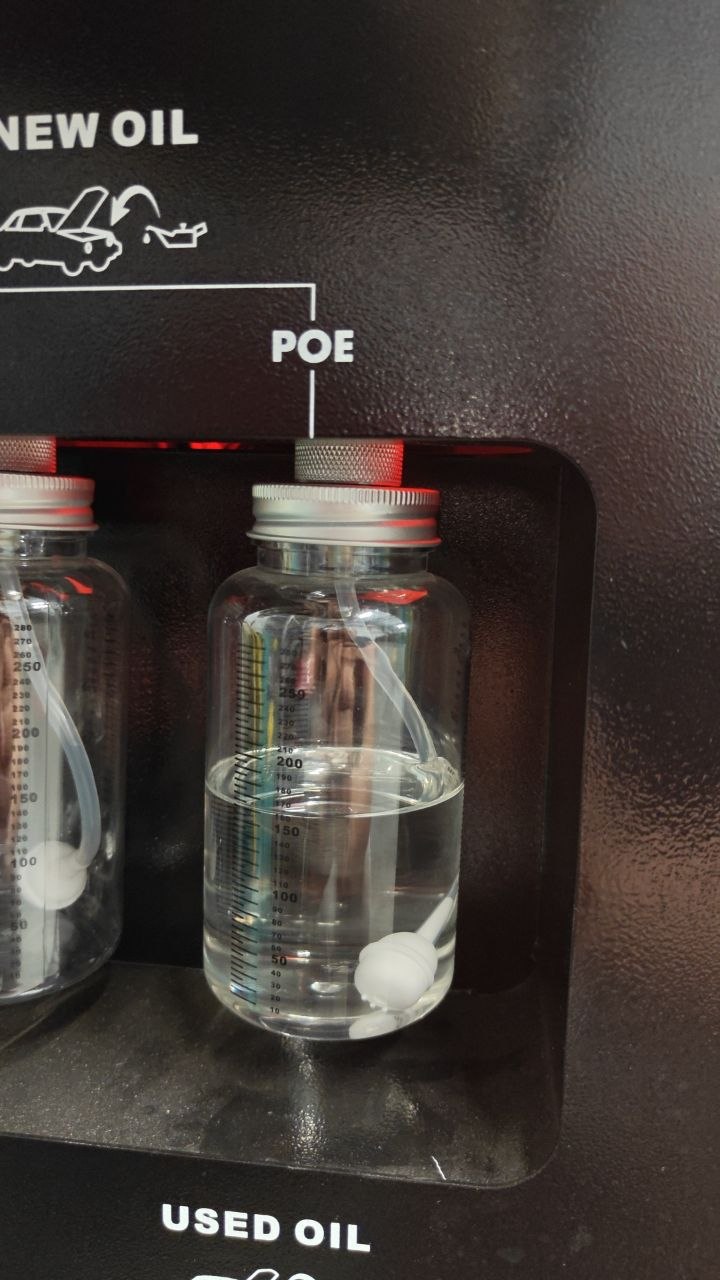
- The Tesla compressor runs off the ~400 V DC high-voltage bus, not off a belt drive like in diesel/petrol cars. That's why the system uses dielectric POE oil. On PAG the compressor "won't die instantly, but it won't live long."
- Viscosity matters: POE 32 is wrong — you need ~80–90. The ideal is Denso ND-11 or analogues with ND-11 approval.
- POE and PAG must never be mixed — the compressor dies. That's exactly what happens with a "top-up" at roadside shops: their rigs almost always carry PAG.
- Overfilling the oil beyond spec also risks killing the compressor.
- Heat pumps fail especially fast after roadside refills.
The takeaway is simple: refill only at shops that know how to work with EVs and hybrids and load the correct oil. Compressors running off the high-voltage system have completely different requirements than those in combustion cars.
💡 Remember: a Tesla is a car that relies entirely on its cooling and heating systems. They must be healthy first — otherwise the other (far more expensive) components start dying: the battery, the drive units, the electronics.
What it costs in Belarus
- $0–50 — DIY cleaning (vacuum/compressed air/mesh).
- $50–150 — professional cleaning without removing the bumper.
- $250–600 — condenser replacement on puncture/corrosion.
- $800–1 800 — A/C compressor replacement on overheat/seizure (with system flushing).
Prevention
- Clean the front stack once per season (especially after the "fluff season").
- Make sure the drains don't get clogged.
- After pressure washes, check that fins haven't been packed with debris deeper inside.
Links
- Tesla Service Manual — Clean Radiator (Heat Pump/Model Y): cleaning procedure recommending a shop-vac.
- Tesla Service Manual — Condenser (Remove and Replace, Model 3): shows the condenser/radiator layout and service access.
- Tesla Owners Online: owners' experience cleaning the condenser/radiator and the impact on efficiency.
https://www.teslaownersonline.com/threads/ac-condenser-cleaning-2018-model.31039/ - General on compressor failure causes: a clogged condenser and poor heat dissipation accelerate compressor overheating/wear.
https://macsautorepairs.com/car-ac-compressor-failure-9-reasons-why-this-happens/
Sources
- https://www.teslaownersonline.com/threads/ac-condenser-cleaning-2018-model.31039/
- https://macsautorepairs.com/car-ac-compressor-failure-9-reasons-why-this-happens/
Related
Full list →Tesla battery errors (BMS): Service Mode codes decoded, what they mean & repair cost (2026)
Full breakdown of the scary Tesla battery codes from Service Mode: BMS_a066/a064/a079 (imbalance), BMS_f107 (sense tabs), BMS_a035/a037 (moisture), BMS_f038 (contactor). What each error means, who it affects (model/year/chemistry) and what the repair costs in Belarus — with links to detailed articles.
12V (16V) battery: bricking and recovery
The 12V battery is a frequent cause of a fully bricked Tesla. How to jump-start, replace, and which alternatives fit.
Which battery does my Tesla have? NCA, NMC, LFP, 4680 lookup by model and year (2026)
Quick lookup table for every Tesla battery chemistry by model and year: NCA 18650 (early S/X), NCA 21700 (US M3/Y), NMC LG 79 kWh, LFP — prismatic CATL/BYD (CN/EU SR), 4680 Texas Model Y. How to check what you have via VIN and Service Mode, reliability ranking from community experience, and which packs are risky to buy used.