Model 3/Y 82 kWh Panasonic (US): frequent module imbalance
Quick FAQ
What does the "Maximum battery charge level reduced" error (BMS_a074) mean?
Why does the car say "Unable to charge — Maximum charge level reached" (BMS_a079)?
How much imbalance between cell groups is considered normal?
Can you just reset the imbalance error?
Which is better: repairing a module or replacing it outright?
Can individual 21700 "finger" cells be replaced without replacing the module?
Why must a Tesla not be left parked for months without driving or charging?
Specific numbers
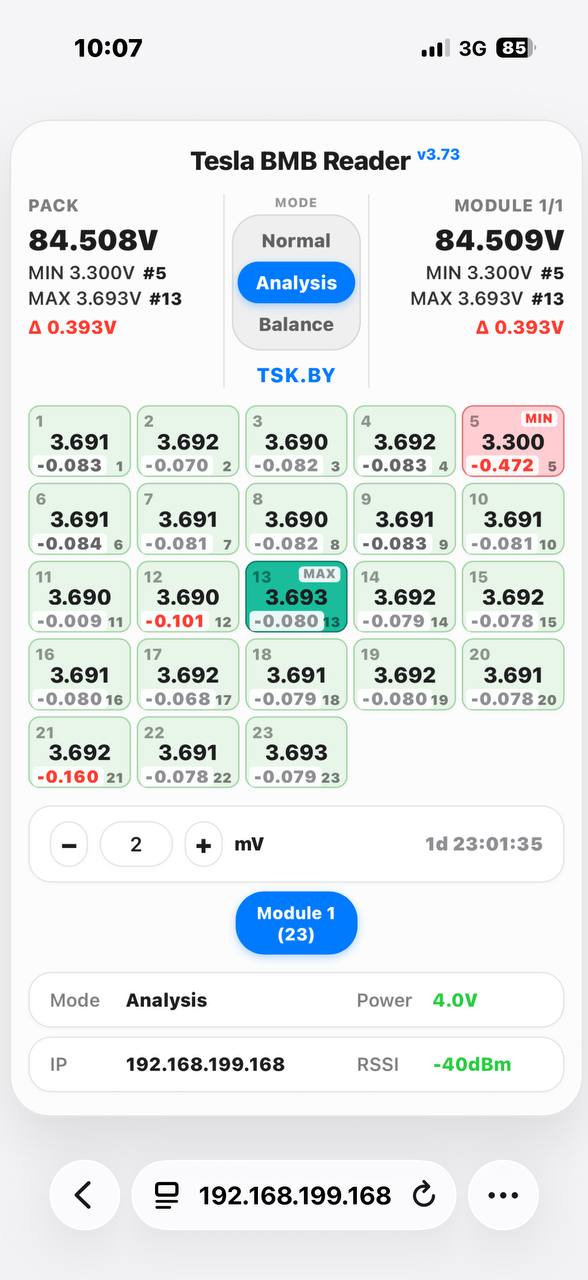
- Healthy battery: a difference between cell groups of 2–6 mV; up to 8 mV is acceptable (tsk.by practice; RTC examples).
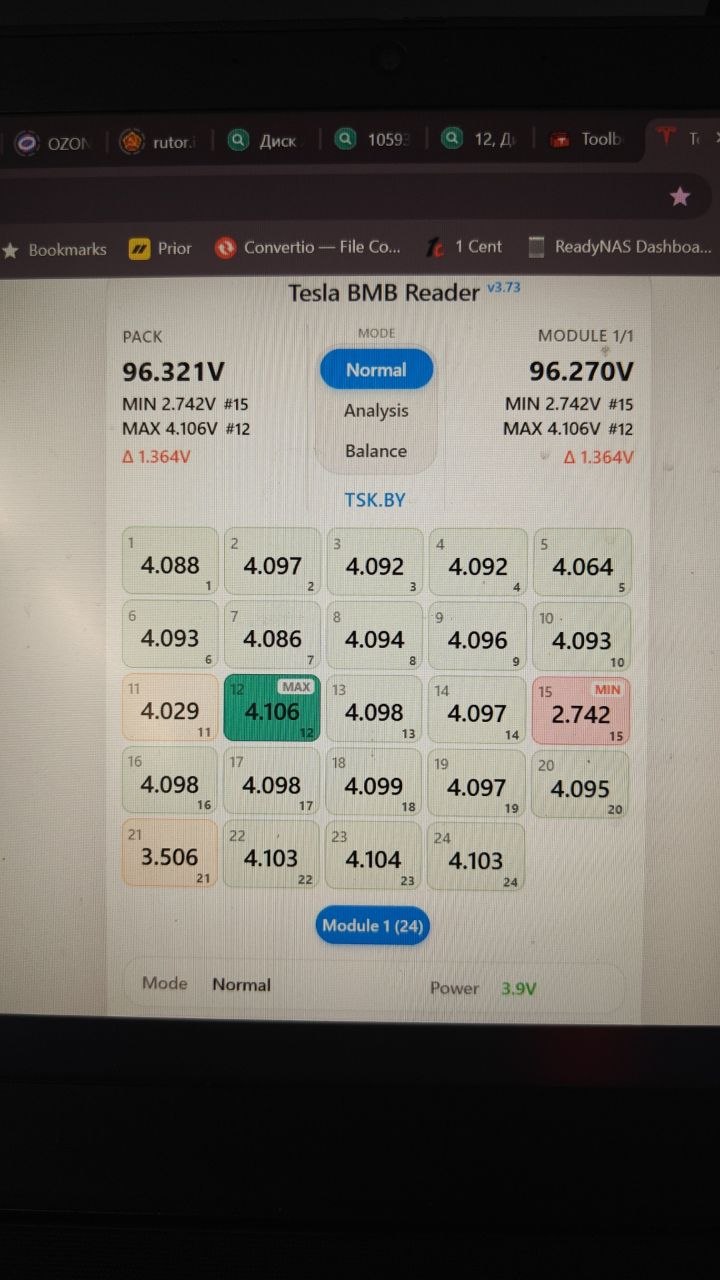
- Alert threshold: >150 mV — the BMS raises an imbalance error (BMS_a029) on the dash and cuts the available charge to ~50% SOC. The user cannot clear it; a service shop can reset it via Toolbox, but without repair it comes back. This is an indication for urgent repair. In chat practice, at ~200 mV the BMS is already hard-limiting power and/or a section replacement is being proposed (t.me/teslacar_chat/656235, t.me/teslacar_chat/680079).
- Real case, M3 LR USA 2019, 80k km: one module of four sagged → it was replaced → then module 3 drifted into a 100 mV imbalance and module 1 into 40 mV. A cascading failure of the Panasonic pack (t.me/teslacar_chat/647526). Caveat: a 2019 car is the early ~78 kWh pack of the same architecture (the 82 kWh pack arrived with the 2021 model year).
- Topology: 96 groups in series (96s) on M3/Y (RTC).
The root cause: the 21700 cells' "fingers"
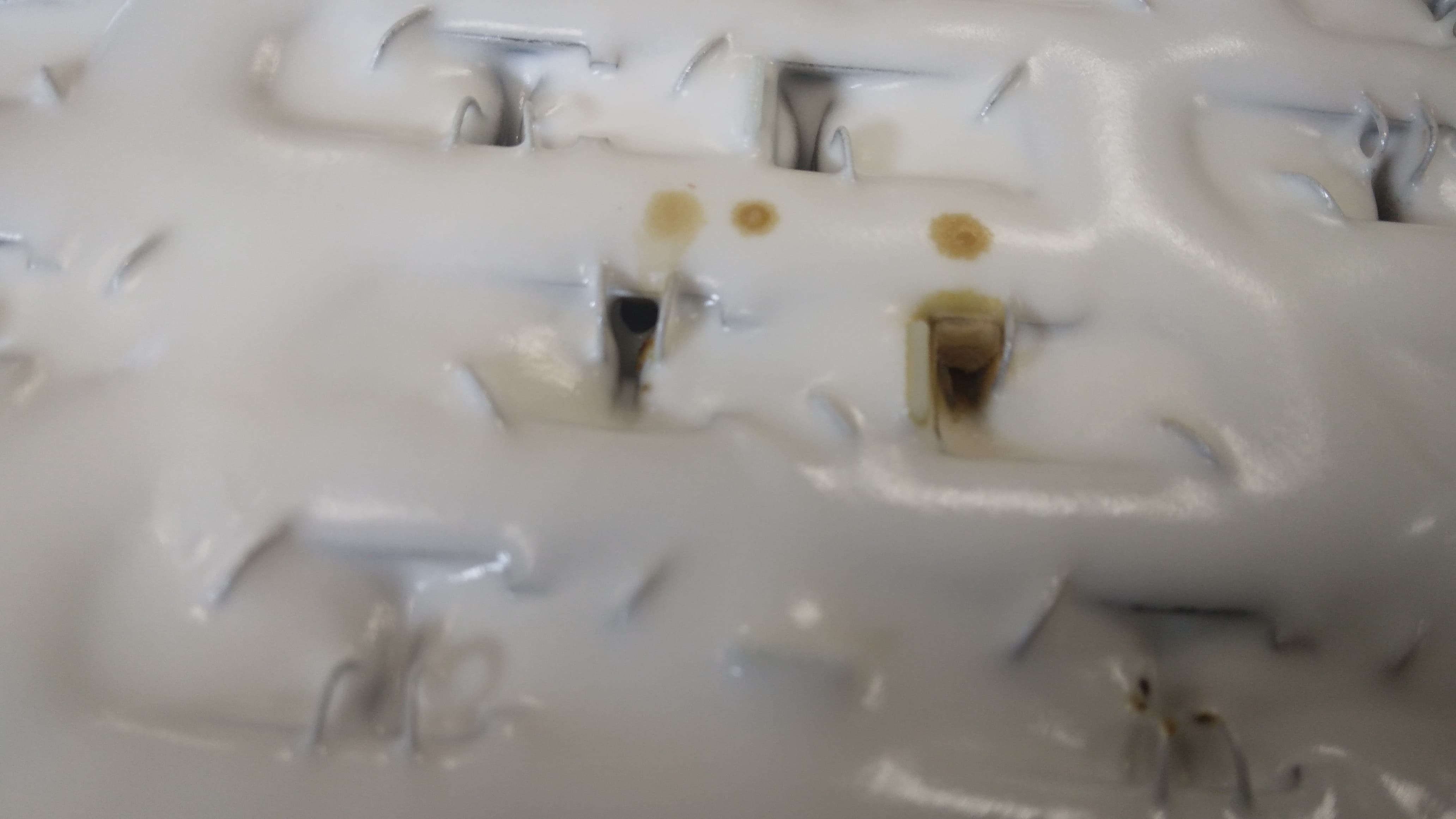
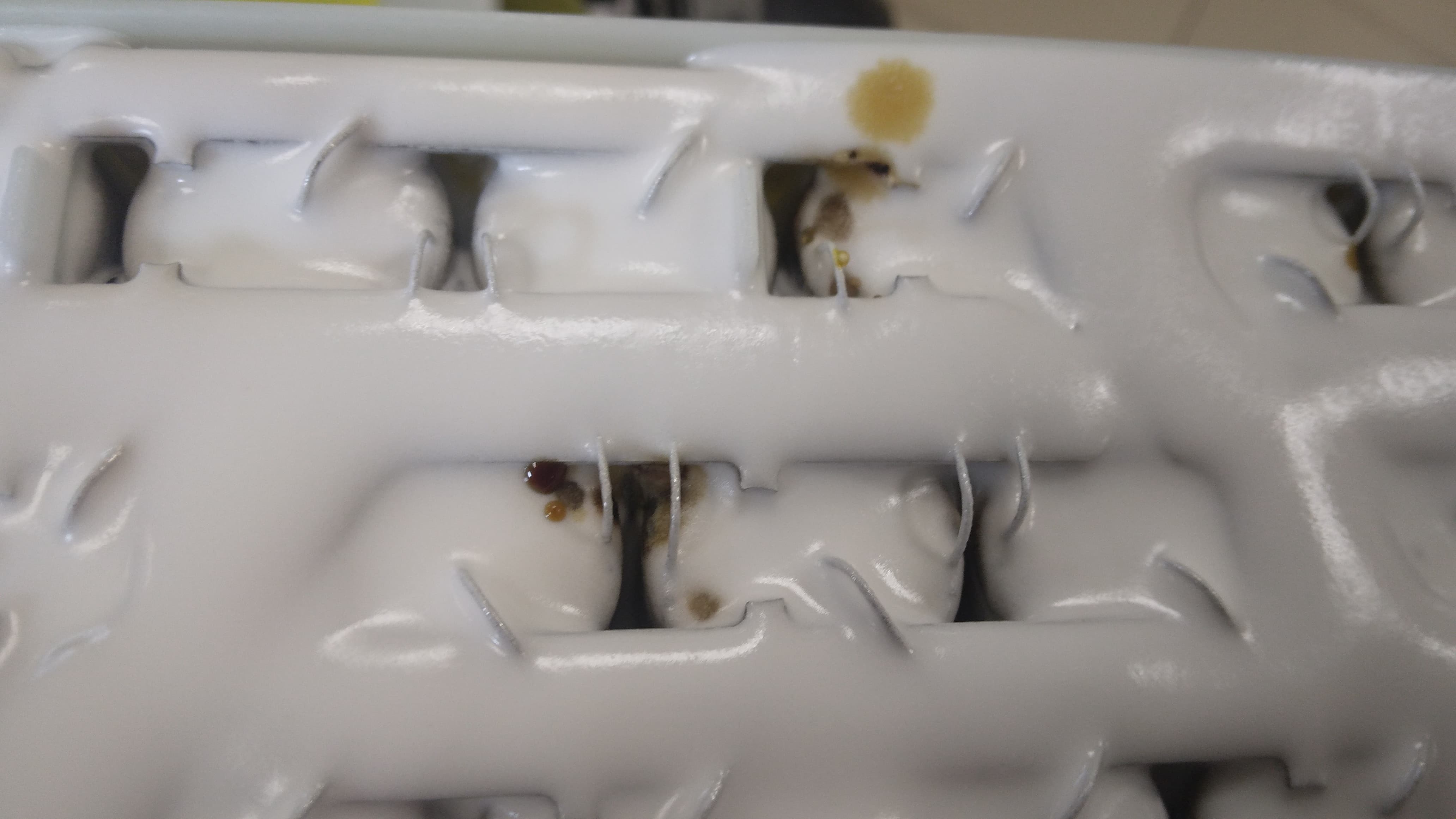
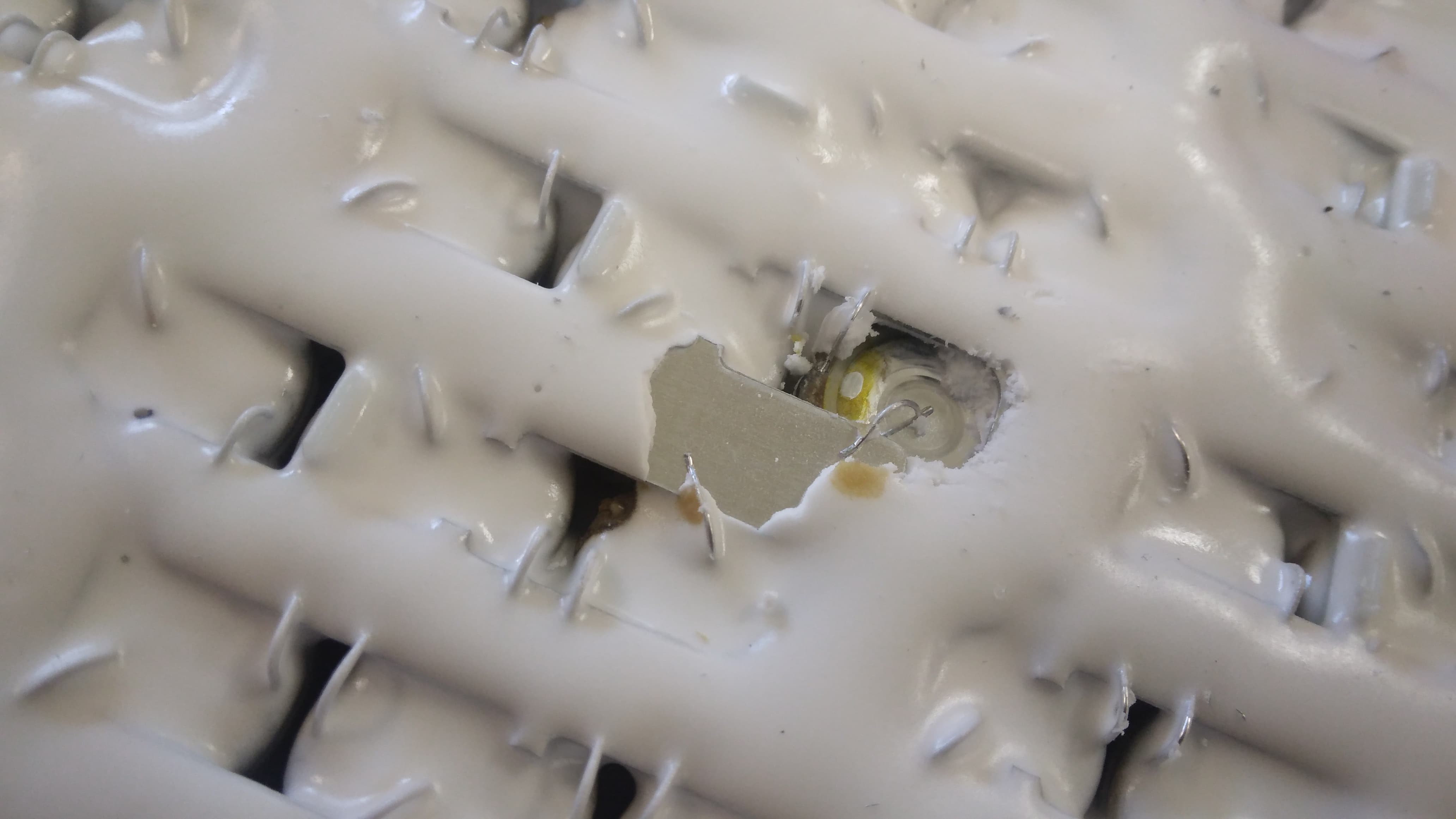
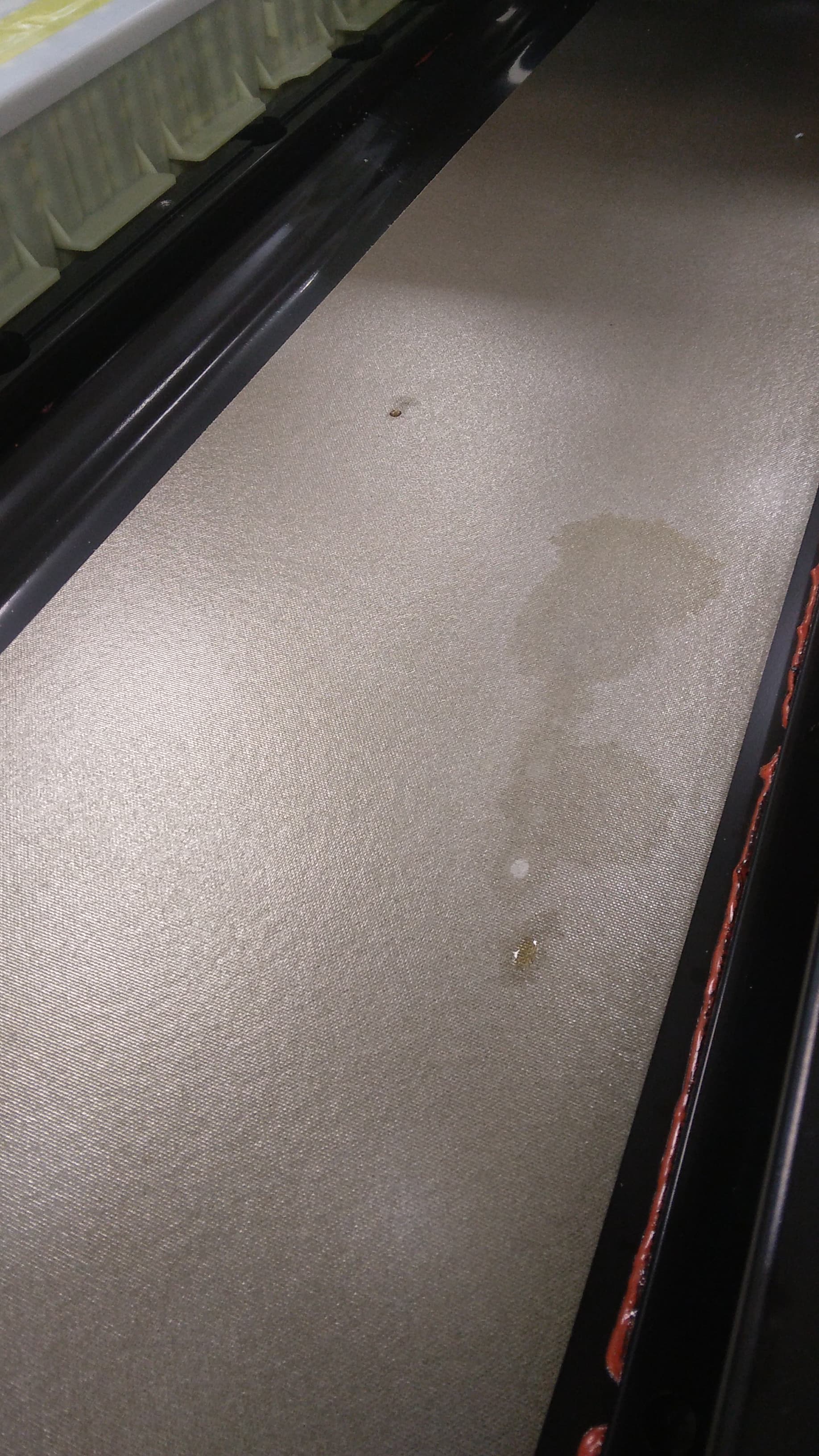
The root of the 82 kWh pack's imbalances is the imperfect manufacturing technology of the "fingers" (fuse-wire leads) of the 21700 cells. A current leak starts through the defective spot: the group self-discharges faster than its neighbors and electrolyte escapes — the photos below show what that looks like. The stock BMS balancer runs constantly, but it cannot compensate for a leak like this — the spread keeps growing until it hits the error thresholds.
BMS codes during imbalance (per Tesla Toolbox)
The typical chain: an internal error sets a charge limit → a customer-facing error reports the limit. The full reference lives in the BMS codes hub.
| Code | Visible to | What it means |
|---|---|---|
| BMS_a064_SW_SOC_Imbalance | service | The BMS sees the SOC difference between the most charged and the most discharged group exceed the threshold. Maximum SOC is cut to 50% |
| BMS_a029_dSoc_Limiting | service | A condition inside the pack (paired with BMS_w117 — a "weak short") requires limiting the maximum group voltage: charging is capped at a voltage of ~50% SOC. Can only be cleared with Toolbox at a service shop; comes back without repair |
| BMS_a074_Max_Charge_Level_Reduced | customer | "Maximum battery charge level reduced — OK to drive, Schedule service". Set whenever any of the limiter errors is active: a064, a029, a067 (CAC Imbalance Limiting), a068 (CAC Imbalance Limp) |
| BMS_a079_Max_Charge_Level_Exceeded | customer | "Unable to charge — Maximum charge level reached": the current charge is ABOVE the reduced limit, and the car won't take a charge until the SOC drops below the limit. Not a charging failure — a consequence of the limit |
What a leaking module looks like (tsk.by photos)
Panasonic vs LG long-term (an important nuance)
The common take "swap to an LG 79 and forget the problem" works in the NEAR term, but over a long horizon the picture is more complicated (t.me/teslacar_chat/706064):
- Panasonic NCA (US Fremont): linear degradation up to ~400k km. Module-level repair is realistic.
- LG NCM 811 (CN Shanghai): higher failure rate of individual cells, growing internal resistance, critical issues by ~240k km. LG modules are often not economically viable to repair — the pack has to be replaced.
So the LG 79 is a good "here and now" solution, but if you plan to keep the car for 10+ years, Panasonic may turn out no worse — not thanks to "balancing" (the balancer runs constantly anyway), but because a sagging module can actually be replaced individually.
What the world's data says (4,300+ cars)
The Belarusian shop wisdom "Panasonics leak" can be checked against a worldwide sample: the crowd-sourced spreadsheet Tesla — Battery State of Health (a tff-forum community project with ~4,300 Model 3/Y records from around the world, including an "original/replaced pack" field). We ran through the whole thing — here is what came out.
Median capacity loss at the same mileage (Panasonic is worse than LG in every bin):
| Mileage | LFP | LG NCM | Panasonic NCA (US) |
|---|---|---|---|
| under 40k km | 4.4% | 3.8% | 8.1% |
| 40–80k | 6.3% | 7.4% | 10.0% |
| 80–120k | 7.4% | 9.0% | 12.6% |
| 120–200k | 7.5% | 10.7% | 16.6% |
The heavy tail — the worldwide face of our "leaking" packs. At 80k+ km, degradation above 15% (the level where complaints and BMS errors begin) shows up in 47% of Panasonic packs (181 of 386), versus 3.4% for LG and 0% for LFP.
Pack replacements. Among those who answered: LG — 0 of 623, LFP — 1 of 959, Panasonic US — 2.3%. And the Chinese Performance 82 kWh packs with the same 2170 cell (listed as "Panasonic 3L MIC", 2021) — 31% replaced (63 of 201) at a median mileage of only ~27k km: Tesla replaced them en masse under warranty. That is direct worldwide confirmation of the defective 2021 cell batch thesis.
Honest caveats. The LG fleet is younger (median age ~21 months versus ~49 for Panasonic), and there is almost no LG data at 200k+ km — so the table can neither confirm nor refute the RTC thesis about "LG by 240k". But at 100–150k km LG is already clearly better: a median of 10.1% versus 15.5% for Panasonic. And remember: the data is crowd-sourced (enthusiast self-selection), and degradation is not the same thing as a leak; but the bloated tail and the replacement rate are good proxies for it.
Symptoms
- Rapid growth of imbalance between groups, prolonged balancing, reduced available power/charge, BMS_a074/a079 errors on the screen.
Solutions (tsk.by breakdown)
The root of the 82 kWh imbalance is a defective cell-batch technology, so there is no perfect option; ranked by the shop's practice:
- Repairing the imbalanced module — diagnostics, finding the current leak, stopping it, balancing. The most effective and affordable option (and tsk.by's position: better to repair than to replace the module outright — nobody will guarantee a replacement module against the same kind of leak). Downside: it does not fix the rest of the battery — there are still ~90 groups that may drift into imbalance down the road.
- Replacing the module — more expensive, and it does not remove the root cause: in effect you install the same kind of module in which the imbalance simply has not surfaced yet. If you do replace it, the donor must be the same year and similar mileage: the modules' capacities must be identical.
- Replacing the entire pack — serious money, and usually pointless: a 2020–2023 pack is the same lottery, with no guarantee against imbalance.
- For the SR 55 kWh: a swap to LFP — a good solution for the Standard Range: the chemistry is more durable over cycles; problems do occur (Chinese build quality), but not imbalance and not en masse.
- Upgrade/replacement with the LG 79 kWh (EU/China) — a more stable option per shop practice, but: the batteries are already old, a good one is hard to find, and LG packs get imbalance too (just not as widely). See the long-term nuance above.
- DIY balancing — not a cure. But if the leak has stopped on its own, there have been cases where the imbalance shrank through the stock balancing means.
- Forced balancing (Tesla BMB Reader) — makes sense ONLY if the imbalance exists but is not growing (the leak has stopped). Then the Balance mode in Tesla BMB Reader will help. If the spread is growing — repair first; balancing is pointless.
Second opinion: individual-cell "finger" repair (pro-tesla.by)
The Belarusian market also offers a more targeted approach — replacing individual faulty 21700 cells ("fingers") without replacing the module. In Minsk it is practiced by pro-tesla.by (Alexey @pro_tesla_am, Dmitry @pro_tesla_dm; service description):
- Pinpoint diagnostics finds hidden leaks and degraded cells in the sagging brick — including neighboring "candidates": if one finger reads 3.68 V while the overall level is ~3.70 V, it is replaced preemptively — "that one will start leaking soon too".
- The faulty cell is drilled out through the module wall and replaced with an original 21700 cell with a carefully matched internal resistance.
- The aluminum tab is welded to the busbar on professional equipment; thermally conductive compounds matched to the OEM specs are used; the module's factory protection is preserved.
- After the replacement the module is balanced to the parameters of the main HV battery. The entire process is photo-documented.
- Logistics: they pick up the removed module and bring it back themselves; turnaround 3–5 days; a 1-month warranty on the repaired brick.
- The master's track record: ~20 cars, no returns (per the master himself — an owner of two Teslas who studied the method after one of them went into errors).
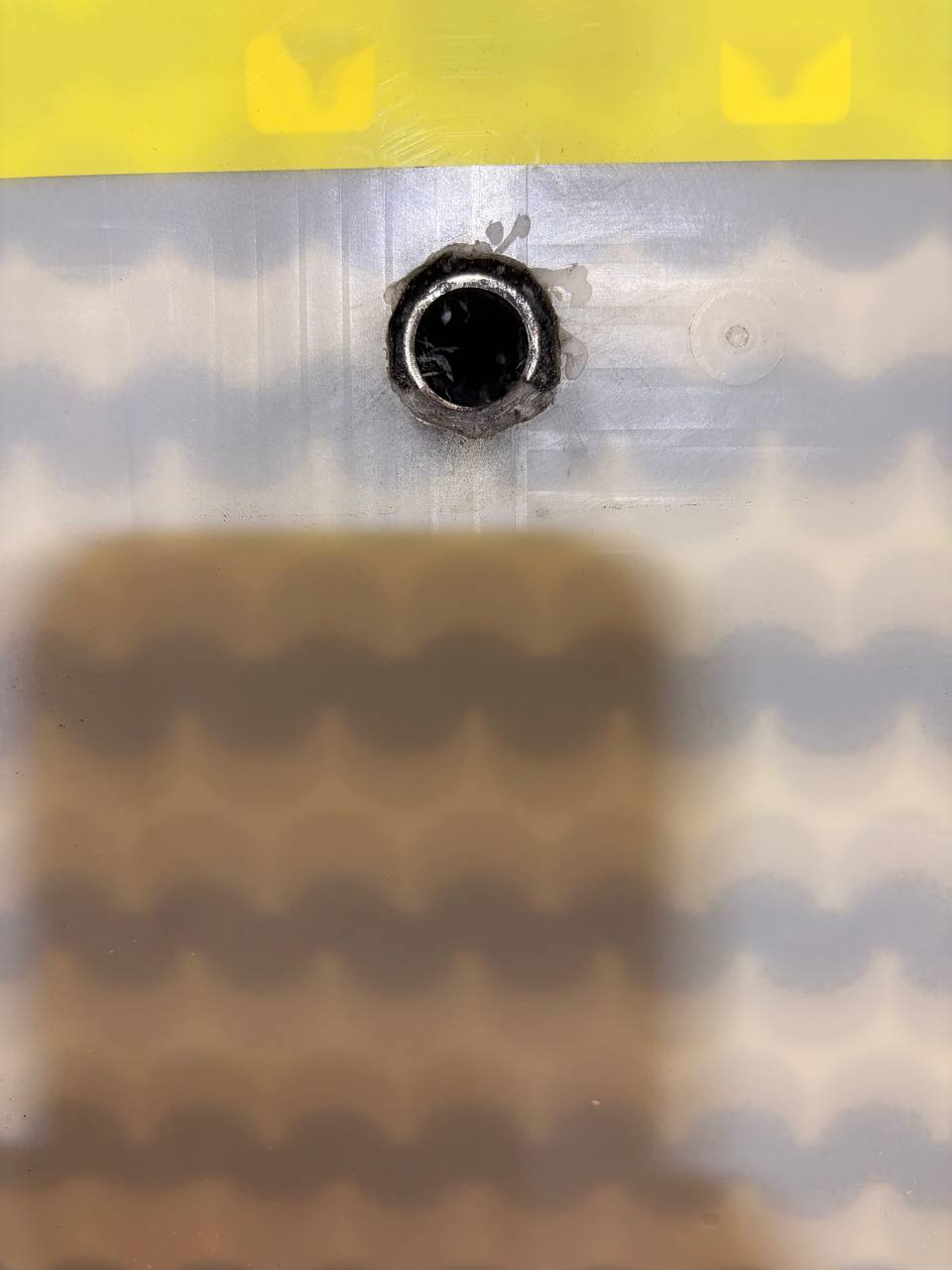
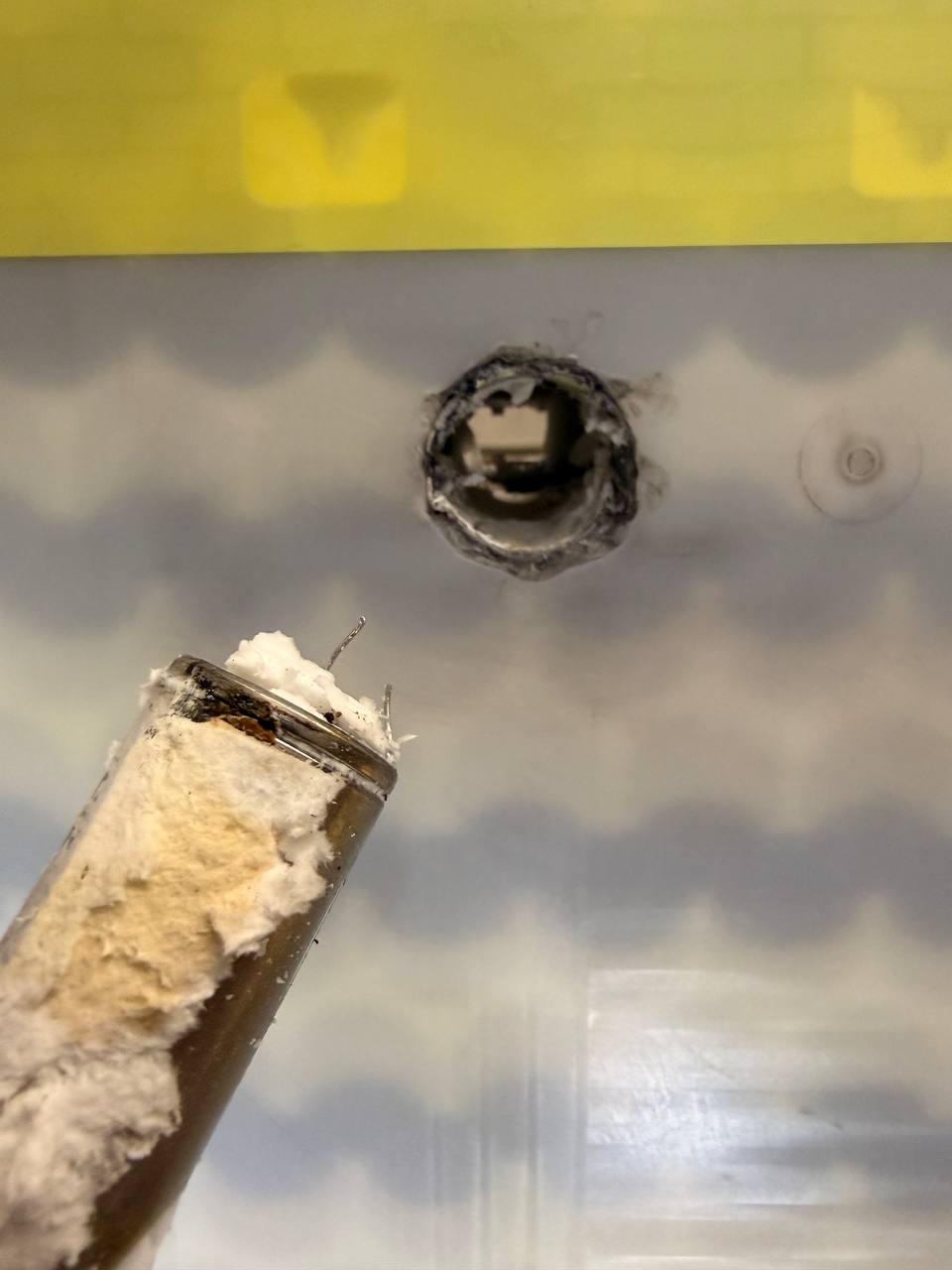
tsk.by's counter-argument (we present both positions honestly): replacing fingers does not fix the root cause — the defective batch remains, so this is a temporary solution; drilling compromises the module's structural frame, and the method carries a fire risk. That said, even tsk.by concedes: the method works.
Our position: this is the cheapest level of intervention in the hierarchy of solutions above — and it is good that it is now actually available in Minsk. When choosing, weigh the price and speed against the frame risks and the short warranty (1 month on the brick versus 6–12 months on a module repair with other methods). And remember the general principle: the more pinpoint the repair of an 82 kWh pack, the higher the chance that the next defective cell will surface somewhere else.
Sleep, sitting idle and balancing
The car balances its cells only with the contactors open — in sleep mode. Hence three practical rules:
- Do not leave the car for long without driving or charging: a couple of months sitting idle is a big chance of coming back to a "brick" (especially relevant for LG packs). Better lend the car to a friend to drive.
- Keep an eye on third-party services (Tessie and the like): they constantly poll the car and keep it from sleeping — and without sleep there is no balancing.
- Periodic slow AC charging to 100% + sleep is the stock routine in which the balancer does its job.
Belarus budget
≈ $1,500–7,000 depending on the scope of work / donor availability.
Community experience TESLA Belarus
Analysis of 400 000 messages from the TESLA owner's group BELARUS chat — one of the most painful topics.
What the chat recommended (in essence — a gauge recalibration, not a cure):
- Discharge the car below 20%.
- Find a charger with 5+ kW that doesn't drop the session on pause (NB, EVICA in Minsk).
- Start Battery Test via Service Mode.
- Wait 12-18 hours — the BMS balances the cells.
- Tesla won't let you run it more often than once every six months (that's a limit, not a "prevention" schedule).
- Do NOT use CCS for the test — only slow charging (Type 2 / Wall Charger).
📝 Note after cross-checking with RTC: this step-by-step procedure is specific to the Belarusian chat — the RTC archive has no trace of it. The general Russian-language consensus (t.me/teslacar_chat/348904): balancing happens automatically during sleep, plus periodic slow AC charging to 100% at low current. We found no specific "12-18 hour" window or "no CCS" rule in RTC. In a real case the effect held for ~2 months, not 6 (t.me/teslacar_chat/220463) — and that is to be expected: a temporary effect means the cells have already degraded, and the constantly running BMS balancer can no longer cope with them. The procedure evens out the readings but does not revive the cells; if the imbalance comes back, the car is a candidate for a module repair or replacement, not endless cycles. If your result lasts longer — share it in @tesla_belarus.
Who reported the issue: Сергей, Shark Dark, Vitali K, AleXXXiz
Who found the fix: Pasha n1claus, Zverski, SΞDΞK, Alex Bor, Stinger
Discussion in Telegram: #259300, #298551, #403809
Additional sources:
- Tesla BMS Calibration Guide: https://ev-inventory.com/guide/tesla-bms-calibration.php
- How To Recalibrate Your Tesla Battery (InsideEVs): https://insideevs.com/news/516137/recalibrate-tesla-battery-range/
Sources
- https://t.me/teslacar_chat/647526
- https://t.me/teslacar_chat/680079
- https://t.me/teslacar_chat/656235
- https://t.me/teslacar_chat/220463
- https://t.me/teslacar_chat/660576
- https://t.me/teslacar_chat/706064
- https://t.me/teslacar_chat/187197
- https://t.me/teslacar_chat/348904
- https://docs.google.com/spreadsheets/d/1LmyllKqJWBr8J_LKVIAimsOigT4-hpfi5NeFJR8qZhQ/edit
Related
Full list →Model 3/Y: HV battery module-level repair — who can do it in Belarus and what it costs
82 kWh Panasonic packs degrade in a typical pattern — one out of 16 modules weakens → imbalance → errors. Good news: a module can be replaced individually. What it costs in Belarus, who actually can do it, and when it's easier to take a refurb pack.
Tesla battery errors (BMS): Service Mode codes decoded, what they mean & repair cost (2026)
Full breakdown of the scary Tesla battery codes from Service Mode: BMS_a066/a064/a079 (imbalance), BMS_f107 (sense tabs), BMS_a035/a037 (moisture), BMS_f038 (contactor). What each error means, who it affects (model/year/chemistry) and what the repair costs in Belarus — with links to detailed articles.
Tesla Model 3/Y no heat in winter: 2021 heat-pump problems, PT-sensor recall, fixes (2026)
Why early 2021 Model 3 and Model Y refresh cars lose heat in heavy frost: PT-temperature-sensor failures in the heat pump, octovalve / supermanifold mechanical issues, the Tesla service-bulletin replacement of three PT-sensors, and what the firmware updates closing 'stuck' valve positions actually do. Symptoms, repair scope, typical cost.